page contents
 
Clouds Don't Cause Climate Change

http://karadene.com/news.php?readmore=

Clouds only amplify climate change, says a Texas A&M University professor in a study that rebuts recent claims that clouds are actually the root cause of climate change.

Andrew Dessler, a Texas A&M atmospheric sciences professor considered one of the nation's experts on climate variations, says decades of data support the mainstream and long-held view that clouds are primarily acting as a so-called "feedback" that amplifies warming from human activity. His work is published in the American Geophysical Union's peer-reviewed journal Geophysical Research Letters.

Dessler studied El Niño and La Niña cycles over the past 10 years and calculated Earth's "energy budget" over this time. El Nino and La Nina are cyclical events, roughly every five years, when waters in the central Pacific Ocean tend to get warmer or colder. These changes have a huge impact on much of the world's weather systems for months or even years.

Dessler found that clouds played a very small role in initiating these climate variations—in agreement, he says, with mainstream climate science and in direct opposition to some previous claims.

"The bottom line is that clouds have not replaced humans as the cause of the recent warming the Earth is experiencing," Dessler says.

Texas is currently in one of the worst droughts in the state's history, and most scientists believe it is a direct result of La Niña conditions that have lingered in the Pacific Ocean for many months.

Dessler adds, "Over a century, however, clouds can indeed play an important role amplifying climate change."

"I hope my analysis puts an end to this claim that clouds are causing climate change," he adds.


Big corporations benefit bigtime from the cloud. They can market their goods ten-times cheaper over the Net. Better for them and worse for consumers. Worse, the big corporations have outsourced their marketing chores. This has given rise to hundreds and hundreds of disreputable websites that place well-known corporations on their banner. For instance, they may claim to be valued partners of Microsoft or Adobe or Oracle or whatever. But these snake oil vendors are nothing but.

Stay clear of extravagant claims and bargains that are too good to be true. The rascals promise FREE downloads or quote prices at steep discounts. They offer services that are either redundant or suspect. They claim to speed up your browsing experience or to get rid of unwanted viruses. Instead they insert adware for their products and their partners. While unsuspecting customers are led from page to page. The software is indeed downloaded for free but the customer needs a key to make it to work.

The vendors offer steep discounts, which later turns into 30-day trials with the same price automatically deducted month after month. The price charged your credit account is quadruple what you've been led to suspect. They take your funds even before their products are activated. When you try to cancel your order, you get nothing but runarounds. These vendors are bandits, thieves and economic terrorists.

Sooner or later, consumers will become fed up with all this nonsense. The shenanigans are bound to undermine the credibility of corporations who offer valid products and services. No one will risk online purchases. And the fabled Cloud will come down, raining cats and dogs. The fallout will spread like a plague. The economy will crash harder than the DOT.COM fiasco. Scooters will go for a dollar a dozen on eBay. Mark my words.


Although consumer advocates may dispute the quality of certain goods and services, transnational corporations have shown they can please most of the consumers most of the time. They do so better than meddlesome governments on the left or the right. Transnats have raised the euthenics of folks on six continents. They ride the thoroughbreds of global commerce. Rumors of collusion among the largest transnats are nothing more than envious gossip, since the behemoths cannot afford to gouge customers, or they would see their market shares stolen by fleet-footed competitors.

Transnational corporations are conglomerates that include producers, bankers, wholesalers and retailers. They operate beyond national borders, so they assume perspectives that have become familiar in the global media. Transnats service a potpourri of dyslogistic cultures. They operate under the guise of absolute neutrality, so they avoid the petty objections from ethnic stalwarts, religious evangelists and patriotic nationalists—all of whom have been ground to insignificant dust in the stampede of prosperity.

Transnats represent the goliaths of the marketplace. They exert great influence over what goods and services are available to individual citizens. Buyers seek to purchase the highest quality at the lowest price, whereas sellers want to sell as many products as possible. Various brandmakers compete to offer the most affordable products. Thus, stores are stocked with large quantities of homogenized products. Buyers may seek out a certain label on beer cans, or they may prefer a special fragrance that comes with disposable diapers—but nobody who shops at hypermalls expects to find beer in glass bottles or reusable cloth diapers.

Buyers remain loyal to brands since their trademarks imply a long history of quality control. Popular brands that satisfy once are likely to satisfy a 2nd- & 3rd-time. The makers of brands absolve consumers of lengthy and difficult decisions. Moreover, if a corporation that produces the brand goes bankrupt, another will assume the mandate.

Products, which offer extended durability or perform uncommon services, are not found in hypermalls. Small-run products don't warrant shelf space or mainstream adverts. Moreover, special products must be priced higher than necessary because they don't enjoy the advantages of large-scale distribution networks. Members of the buying public have to search diligently to locate uncommon goods in the vast maze of the marketplace. In some cases, durable products are sold strictly to corporate buyers—such as heavy-duty power tools for house builders and renovators, oversized trucks for strip-mining companies, special-effects software for holo producers.

Transnats have grown so large that they have become impersonal, monolithic and hierarchical. Their operational structure, their goods and services remain in effect, even after drastic changes in management. Transnats are dedicated to making life more convenient for their customers. When they succeed, it's hard to begrudge the wealth they accumulate—especially when some of the wealth filters into the communities in which they operate.

Indoor plumbing, refrigeration, effortless transportation, global communication and digital memory enhancements are things we have grown to depend on. Consumerism embodies the postmodern paradigm, and transnats are the glue that holds it all together. Their hands guide the reins of the wild mustangs that rear the global economy. Although commercial conflicts may be held responsible for regional booms and busts, economic warfare causes very little bloodshed.

Transnats have extemporized a large slice of the democratic process. Why? Because governments depend and are influenced by corporate policy which is decided in secret behind boardroom doors. The leaders of large corporations have a larger stake in economic prosperity than the multitudes that enjoy its benefits.

Whatever you think of the transnats, they are a fact of postmodern life. They are unlikely to fade into extinction—not tomorrow nor in the foreseeable future. It's no fluke that they have assumed leadership roles in the global marketplace. They profit from processing raw minerals as easily as they profit from trading digital securities on public stock exchanges. Transnats are too big to fail, so governments of all stripes will rush head-over-heels to grant them concessions.

Competitive markets, merchandise and merchants are as old civilization. Imperial Rome had a lively futures market in real estate. The dynasties of China tested their mandarins for worldly knowledge, so that local administrators had enough savvy to balance the emperor's whims with common prosperity. Egyptians devised practical trigonometry, which enabled them to restore the ownership boundaries after the annual overflows of the Nile.

The freedom—to engage in unfettered trade, to earn wealth and own property—is engraved in the human psyche and is practiced by humans everywhere except in the communities of spacer colonists.

What good can one say of spacer colonists? At best SOAR is a blip or cul-de-sac on the evolutionary highway. Throughout recorded history, egalitarian socio-economic systems have never proven workable over the long run. Thus, wise observers should regard SOAR as nothing more than a passing fad that will consume itself in the flames of its misguided policies.

SOAR has risen to prominence on the unexpected success of its beamersats. Spacer colonist went into space at a time when many coastal communities were suffering from climate change—at a time when the largest trade blocks put their differences aside and agreed to reduce greenhouse gasses. Prominent national and commercial leaders placed their hopes on the development of fusion reactors. This farsighted strategy would have succeeded if not for the disaster at Mogadishu. Meanwhile against all odds, spacers commandeered a near-earth asteroid and processed enough raw minerals to build the first beamersats. SOAR has prospered because it has supplied a needed solution at the right time.

No one denies the benefits of beamersats, which furnish one-third of the earth's energy needs. No one denies the important role that SOAR plays in maintaining the world's comsats. No one truly cares if depraved social customs are practiced in the soupcans, which orbit as far from earth as the moon. As for the dearth of trade between the spacers and earthsiders, most folks understand the penalties incurred when moving up and down the gravity well. Costwise, it makes more economic sense to beam microwaves at earth than it does to bring down truckloads of uncut diamonds.

SOAR has earned undeserved praise and acceptance in the General Assembly of the United Nations. Their suggestions appear to favor the aspirations of 3rd-world peoples, but such drastic measures would cause major disruptions in the economies of developed nations. A worldwide depression would make losers of everyone, both rich and poor.

Ecologists have applauded SOAR for its ecological strategies. Outer space habitats cannot support life unless residents keep strict control over the molecular inflows and outflows. Hence, spacer colonists take a radical approach to their environment, rationing every drop of water and every breath of air. Ecologists praise such attitudes and urge earthside governments to adopt SOAR's environmental strictures. But to introduce such measures without careful forethought could sink most jurisdictions into decades-long recessions. For instance, if governments and corporations were forced to report losses on the extraction of natural capital, they would bleed red ink all across the globe. It would be dangerous to force consumers into environmental straightjackets before such measures become economically feasible.

Let us consider some of the bizarre protocols of SOAR's socio-economic system. Everyone, from the highest-ranking savant to the lowliest bottle washer, earns identical wages. Consumers have no choice; they must buy one brand of nail clippers, one brand of palmslates, one brand of vidcoms, one brand of garden hoes. In short, cooperatives are given five-year monopolies to produce the goods and services. What's more, these monopolies are awarded according to a complex computer model that gives only cursory nods to consumer cravings. The model favors ecological propriety and human health, and its parameters are set so high that many commonplace items are saddled with prohibitive taxes. Disposable gadgets, refined sugar, carbonated beverages, inorganic make-up, animal foods—all cost more than thrift-minded folks are willing to pay. Imagine paying 35 euros for a breakfast of bacon and eggs!

Although worship is tolerated, SOAR does not allow tax exemptions for religious activities, unless clergy can prove their activities render charitable results. Worshipful gatherings are not deemed to be charitable, so denominations cannot afford to build churches, temples or mosques. They must rent or beg temporary venues for their services.

When you curtail established religions, you are giving hedonism a free reign. Hence, marriages and families have become scarce in SOAR communities, while surrogate parents have taken over the raising of the children. What results is a society of loose morals and overt permissiveness. Adults may take all kinds of recreational drugs, but they must also suffer the exposure of constant and invasive surveillance.

Every SOAR adult belongs to a cooperative which produces a good or service. Misguided wags have trumpeted SOAR co-ops as instances of exemplary democracy. Cooperatives are autonomous so long as they receive the highest score from a computer model, which gives them a monopoly to market their product for five years. In other words, co-ops are slaved to the whims of a computer. Moreover, SOAR claims to have eliminated political shenanigans, since elected officials are toothless and co-op members are canvassed directly on community-wide issues. However, senior co-op members accumulate shares year after year, and their vote counts as a multiple of shares they own. No valid democracy should allow one-person's vote to count 70 times, while another's counts but twice.

It's not surprising that a majority of SOAR's citizens are refugees from war zones or failed states. The refugees don't question SOAR's bizarre customs because they are grateful for guaranteed jobs and decent accommodations, and they are willing to accept the vegetarian diet and the lack of choice in the marketplace. SOAR wastes no time before it sequesters their children and gives the kids 16 years of indoctrination before shipping them out to the soupcans. As well, SOAR attracts a small number of discredited scientists and engineers along with a number of ostracized dissidents. How the refugees and the renegades get along is anyone's guess. No doubt, SOAR would have collapsed years ago if not for the healthy stream of income from its beamersats.

Three decades ago, SOAR established TCP on the Canadian westcoast. This encroachment poses the greatest threat to our status quo, since TCP refuses to participate in the normal channels the global trade. Self-reliance may be celebrated among small-minded adherents, but any contraction in global trade will bring a decline in global prosperity.

Rome flourished because its armies and navies allowed merchants and merchandise to move freely through all regions of its empire. Rome was able to bind dozens of ethnic traditions since they enjoyed the mutual benefits of trade. When Rome's armies and navies grew lax at patrolling the roads and sea-lanes, bandits and pirates began to disrupt the flow of merchandise. Roman empire fell apart as trade diminished, since there was no common interest to bind its disingenuous regions together.

The lessons of Rome can be applied to any nation or trade block. The most prosperous nations encourage the greatest volume of trade within their borders. This same axiom applies to global trade. We have enjoyed relative peace for the last 125 years because folks value consumer goods more than they value the dubious merits of war and conflict. When a rogue stare restricts trade and closes its borders to outside influences, it will likely adopt a xenophobic mindset; the region will enlarge its armies and stockpile war materials, and it will become a definite threat to its neighbors.

TCP poses such a veiled threat. On one hand, it has earned praise for accepting refugees from troubled spots around the globe. On the other hand, TCP has adopted socio-economic measures that restrict trade to and from other nations and, indeed, to and from other provinces of Canada. One wonders if Canada has second thoughts over the devil's pact it made with SOAR.

Canada, of course, has long been vilified for being the highest consumer of fossil fuels per capita. When Canada suffered a catastrophic flooding on its westcoast, it's easy to see why the Canadian government sought an unholy alliance with SOAR. TCP has reduced the reparations Canada must pay to the environmental tribunal. Meanwhile the numbers of refugees that TCP accepts has boosted Canada's standing in the United Nations.

On the surface, TCP appears to be a friendly community with an abundance of good will. However, many observers overlook the construction of the Tsawwassen megadome, which was funded entirely from the profits of the beamersats. No earthside developer would have agreed to such scrupulous building codes. SOAR may claim that Tsawwassen will last for hundreds of years, but these claims have yet to be proven.

TCP doesn't allow private ownership of residential homes or industrial parks. Individual and organization are forced to sign lease agreements, which may be forfeited for lack of compliance. TCP boasts of its system of ecological stewardship. It claims to have found a better way to manage its lands and coastal waters, but the solution is draconian and comes at the cost of personal incentives. Ditto for its method of eliminating income disparity. Who would want to live in a society where everyone makes identical wages?

Many of SOAR's maxims appeal to youngsters and university students who are famous for sharing pie-in-the-sky ideas via online forums and chat groups. It's easy for students and vagabonds to demonstrate against wealthy executives. Their motive is envy. They want the benefits of success without earning them.

SOAR is like a wolf in sheep's clothing. The lifestyles of spacer colonists have engendered praise from enthusiasts who are incapable of seeing the drawbacks. SOAR is a one-time wonder. The orbital slots for its beamersats are 70% filled. When beamersat construction becomes scaled down to mere maintenance, the colonists will look elsewhere. They will likely expand their bases on the Moon, Phobos and Mars. Their concerns will move away from earth. Anyone, who has been foolish enough to adopt their bizarre socio-economic system, will be left in the lurch.

—Chad Ford, Beware The Apocalypse, 2071


The original demonstration in New York has spread to other cities across North America. In some ways these demonstrations are related to demonstrators in Greece as well as the demonstrators in the Middle East that have been dubbed Arab Spring. The common threat is that folks are fed up. They feel left out of the decision making process. They have been burdened with hardships out of portion to what they deserve. 

In a badly regulated economy, there are too few jobs for folks who need to make decent living. When there is widespread unemployment, small businesses suffer. Restaurant owners, shopkeepers and cabdrivers can't find enough customers to make ends meet. A sluggish economy affects everyone to a some degree. But folks who live on or near the poverty line are the ones that suffer the most. More of the population is affected when wealth is concentrated among a select few. 

Suppose ten fellows decide to share a pizza. One guy volunteers to collect the money and then pick up the pizza. When the guy returns and opens the box, there is only half of a pizza to share among the others. You can bet the other nine are going to complain. Since each contributed an equal share, each deserves an equal slice. 

Fast-talking lawyers, advertisers and spin-doctors have set down the format. Everyone goes along because the format adapts the same ground rules that humans have used thru-out history. Here's how it works... 

An entrepreneur thinks of a better way to provide a product or service. The entrepreneur convinces friends or associates to bankroll the idea. If the concept takes off, the lenders get their money back with interest. Customers are satisfied with a better service or product. The entrepreneur makes a huge profit, sells his business and retires to a Caribbean paradise. On the other hand, if the idea fizzles, the entrepreneur's customers complain and demand their money back, while lenders start hounding the entrepreneur. He or she is in the same situation as the guy who must explain why he ate half of the pizza. 

Nowadays of course, it's uncivilized to lynch a greedy pig for gorging on half of a pizza. We have bankruptcy laws. When you ask a successful businessperson if he or she deserves such extravagant wealth, the businessperson will say, "Yes! I took the risks when no one else would." In fact, entrepreneurs take very little risk. At worst, their credit rating takes a beating, and they might waste a few months or years of their life. Even major corporations can afford to fail utterly, because governments are ready and eager to a bail them out. Unfortunately the same isn't true for an unemployed welder whose bank has repossessed his house. 

It all comes down to awarding fair pay for an honest day's work. Every job is necessary to a smoothly functioning society. Yet, some jobs pay hundreds of times more than others. Our socio-economic system doesn't award fair compensation on a consistent basis. The current system is like a monopoly game masquerading as a fair and equitable system. 

Every business seeks to acquire a dominant market share. What happens is you get two or three major players and a handful of startups. If any startup shows genuine promise, one of major players will gobble the newbie up. The system is skewed to keep major players on top, since they have sweetheart deals with suppliers and retailers. Sometimes they own or control the suppliers and retailers. 

In recent decades, large corporations have become multinational, which gives them extra leverage vis-à-vis their workforce. If workers of one nation threaten to strike, the corporation will shift production to branch plants in other nations. Likewise, corporations have gained more leverage with governments. If the local tax becomes too burdensome, the corporation will move its operations elsewhere. 

How can we bridge the gap between rich and poor? 

First, let's quit playing monopoly. Let's try another game that has different motivations. Competition must still remain a primary motivator. Without competition, you will get stagnation, couch potatoes and complacence. Without competition we would still be burning candles and riding inside horse-drawn carriages. However, we can and should compete for a different goal than wealth. Let's compete for dignity and self-respect. A person who treasures dignity and self-respect won't eat half of the pizza that's meant to be shared with his fellows. The guy would bring a whole pizza and relish the slaps on his back from his friends. 

Autonomous cooperatives would make better socio-economic units than the present day corporations.  

This concept has been dramatized in "Rundog" and elaborated in the forthcoming "Cool Assassins." Check them out...
 
 
The January issue of Scientific American printed an interview with Vinod Khosha, who's a new-breed investor targeting green technologies. Among the companies he backs are: Ecomotors, Amyris, Caitlin and Calera.

Ecomotors makes internal-combustion engines with opposing pistons. Its engines are supposed to be 50% more efficient. Assuming this is true, the projected number of cars, populating the world's roadways, will more than double over the next 50 years. Hence, the total amount of carbon emissions will keep growing.

Caitlan is working on a new method to deliver air-conditioning. They claim to have developed a totally new thermodynamic cycle. In a few years or decades, we might be driving cars running Ecomotors and cooled by Caitlan technology. Both of these innovations will simply keep carbon emissions at the same levels they are today. Scientists promise that our present carbon emission, if continued unabated, will land us in very hot water.

Amyris engineers microorganisms to convert sugars from biomass into biofuels, whereas Calera has developed a process that captures carbon dioxide from power plants. All four of these technologies should make a difference. But will they come onstream in time to matter? There is no real incentive for investment banks to push green tech over, say, oil sands expansions. Unlike Europe, windmill companies get no longterm encouragement from government policies.

Shuffle the deck thoroughly. Cut the deck in half. Throw exactly half away. And now you start playing Texas Hold 'im. There's no way to guess whether there are four Kings or three Kings or two Kings or one Kings or no Kings. How can you make a rational bet? You can't. At best you make a wild guess.

This is exactly the dilemma of our best economists. The GDP, the monetary ratios, the price of real estate, the percentage unemployed, the weight of manufacturers' inventories... None of these things are related to Nature's books. It is said that God knows when single insect drops dead. Whether you believe this or not, Nature "does" record whenever its creatures die and whenever they flourish. Species respond to, and thrive in, whatever resources their environments allow.

Capitalism operates according to the laws of supply and demand. For example, if large numbers of tuna swim in the oceans, the value of tuna in the supermarkets is modest. If fishers catch too many tuna, the numbers left swimming decrease, and the price of tuna goes up. Capitalism has a built-in incentive to catch more and more tuna as the price goes higher and higher. The last tuna caught may fetch $700,000 per pound. Afterward nobody will catch a tuna at any price!

Trickle-down economics should get a new name. Let's call it vapor-up economics. OK? Just like the old Indian Rope Trick where the magician commands a rope to stand upright with no apparent support, then the magician monkeys up the rope, and when he reaches the top, both he and rope vamoose into thin air.

In a like manner, the price of real estate changes according to supply and demand. Sooner or later a clever group of investors will gobble up all the prime real estate, after which they can set rents as they please and transform the land any way they please. If they drain swamplands to build strip malls, they are applauded. No one bothers to ask migratory ducks what they think about the loss of habitat.

The Middle East again! Tunis or Egypt or whatever. All of these nations have similar class structures. The big property owners (2% or 3% of the population) control 95% of the wealth. The poor are bearing the brunt of the global recession. Naturally they're blaming the governments which have, no doubt, cozy arrangements with the landlords and major corporations. Here in North America, we call it political patronage. In the middle East, it's graft and corruption on a monumental scale. Egypt is the ultimate pyramid scheme.

"It ain't what you know; it's who you know."

Egypt makes Bathist Iraq look like laudable democracy. From what I'm hearing, the Egyptian regime employs a good 15% of the population. Many of these folks are the internal security police who no doubt act like mafia henchmen collecting "protection" money from all the little shop owners and restaurateurs. Doesn't that sound like Iraq's Republican guards? The only difference is that Egypt tolerates Israel and is a welcome partner in the Global War On Terror, so it receives 1.5-billion a year in US aid.

At least Iraq held regular elections, even tho they were rigged. Education from grade one to the collegiate post grad was free for anyone in Suddam's Iraq. It was even available to suspected terrorists. I refer to the Kurdish woman who was a celebrity in Europe after 2003. Before the 2nd-Iraq war, she joined a cell of Kurdish dissidents. Then she was arrested and interrogated and occasionally tortured for six months. After her release, she was allowed to continue her college courses. But instead she fled wisely to Europe. Later during the early years of the occupation, she returned to Iraq and described how the country had gone down hill. Neighborhoods were no longer safe. Violence, bombings, grudge killings happened almost every day. She was very critical of the coalition's occupation. Mind you, some of her concerns have been addressed. Next time our politicians suggest "nation building," let's hope they have a comprehensive plan in place for the aftermath before the bombs start falling.

In many ways, the invasion of Iraq is indirectly responsible for the 2008 economic crisis. Bush was lowering taxes (especially for wealthy investors) even while he was planning the 2nd-Iraq war. The 1st-Iraq war was bankrolled by Japan, Germany and Saudi Arabia, altho Saudi Arabia got a kickback from the spike in oil prices. The 2nd-Iraq war has been borne by US tax payers, altho it may not be all that apparent because the Federal Reserve has been doing some creative accounting, so they can keep the mint printing greenbacks "come hell or high water." Well in 2008, the Fed found itself awash in the Red Sea. Massive deficit spending plus lower tax revenues equal lots of red ink.

Who's to blame? Why not 1st-time homebuyers?

Wait a minute! How does 60-billion of delinquent loans turn into a one trillion dollar bailout? And still counting. By the time US taxpayers pay back the interest on their national debt, they could buy all the residential and commercial properties in North America three times over. This is a capitalist nightmare that doesn't make any more sense than the market valuation in 1985 that put twelve blocks in downtown Tokyo equal to the entire city of Los Angeles. Wampum. Big wampum.


Money corresponds to ephemeral code inside electronic databases. In a market driven economy, money is the measure that sets values to goods and services. It functions as a convenient proxy for social exchanges. Let us suppose a person trades eight hours of labor for a five-star dinner. At another time and circumstance, the same 5-star dinner may cost the same person four hours of labor. For another person on the same day, the 5-star dinner may cost 21 hours of labor. Money itself changes its intrinsic value over a span of time.

Money exists without strict limits, and it floats free of gravity. Hence, money is subject to irrational flights of perception. It is the root cause for the extravagant bubbles of prosperity and the gloom of misfortune. Money is the perfect candidate for Einstein's Theory of Relativity. It has never been managed successfully for more than a handful of years. Although seemingly fluid, money does not flow freely throughout a society. The greater percentage of it is sequestered by governments and financial institutions.

For nominal fees, bankers keep tabs on commercial transactions. Investors set monetary values in lieu of future expectations. Government watchdogs validate financial records to maintain public trust.

Money is not free. It carries hidden charges beyond normal accounting fees for commercial transactions. First, central banks retain service fees before they pass money onto investment banks which retain more service fees before they pass money onto local branch outlets which, in turn, skim off accounting fees or charge interest for loans. Second, postmodern markets cannot function without public exchanges that hedge the values of currencies, treasury bonds, stocks and commodities. Market players are rewarded for making selective bets to determine not only current prices but also prices at various dates in the future. This rating system amounts to "consensus guesswork" since no one knows what the future may hold. By the time spendable cash falls into the hands Joe Public, its value has already diminished by multiple handling charges and the inherent pressures of inflation.

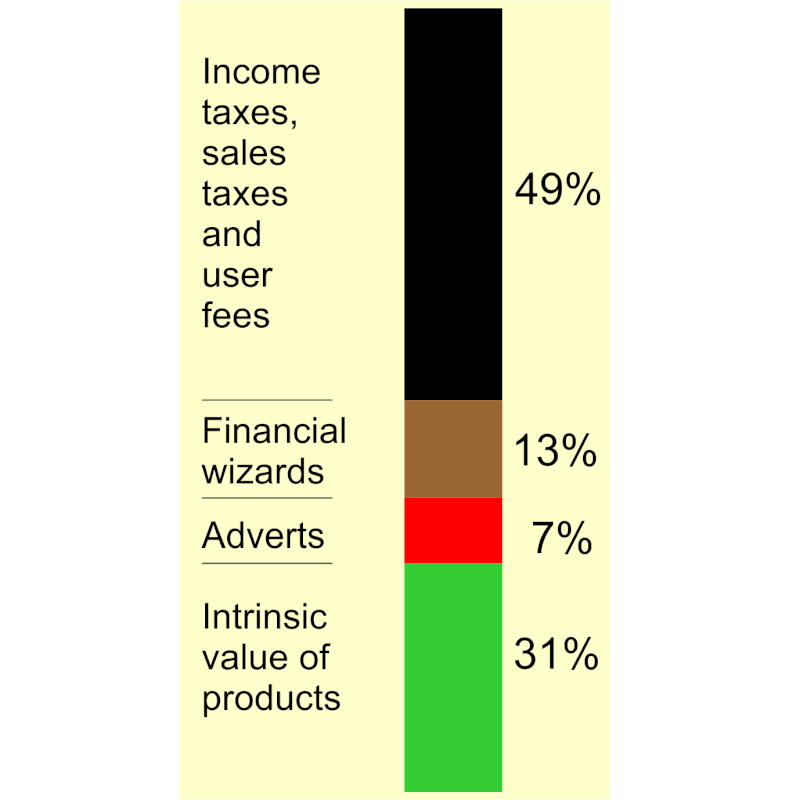
In other words, financial players increase the cost of products insofar as the producers of goods & services depend on market makers for loans, investments or trademark exposure. Such capital costs are eventually passed onto consumers. Financial markets consist of institutional traders, brokers, arbitrators, bankers, lawyers as well as investment firms. These players expect a decent return, so they inflate prices without adding any real value. Advert costs add more tinsel to retail prices. If markup prices are set twice as high as the production and retailing costs, consumers get only half-value for their cash, which is in itself vanishing down the inflationary sewer.

The system of high finance brings order and efficiency to international trade, and for this several layers of middlemen exact heavy tolls. Well-established corporations reap full benefits from a cadre of market makers, but small startup firms cannot afford to grease the palms of so many intermediaries, even though middlemen are needed to bring prototypes into mass production. Small firms must seek sponsorships vis-à-vis friendly backers or unfriendly buyouts from larger corporations. In practice, small firms tend to be cannibalized by the behemoths. Transnational corporations do little but manage hundreds of affiliates that provide the actual goods & services. Even so, the transnats employ thousands of workers whose salaries are ultimately paid for by consumers.

Financiers accelerate the flow of money as they draw on private pools or national reservoirs. Retail prices depend on the liquidity of exchange as well as the amount of money in circulation. If the money supply rises faster than economic output, prices will skyrocket. If the money supply falls below economic output, prices will drop while bankruptcies and unemployment rise. Fast money stimulates consumer demand and begets Ponzi schemes, while scarce money brings on the scavengers that gobble companies unable to generate sufficient cashflow.

Despite "hidden" costs, market capitalism has proven it can gratify consumers and reward skillful employees. Money signifies success in the urban game of euthenics. In developed nations, more than 90% of the workforce has moved from primary industries to service-oriented jobs. Automated assembly lines and laborsaving devices aid shopworkers and repairpersons. Hard physical labor is relegated to fitness clubs or prison work gangs. White-collar workers have more consumer choices than ever before. They may select from multiple brands, each providing similar or identical functions. There is a media-driven impetus to buy the newest, cheapest or "hottest" products on the market, which leaves domestic abodes cluttered with stuff that has been used once or twice and then set aside to gather dust.

Corporate venders don’t really care what happens after the sales have been made. End-users are responsible for usage, maintenance and disposal. End-users must pay fees or taxes to have garbage removed and waste water sanitized. Business leaders tend to downplay the environmental side effects caused by postmodern industry. They ignore the infrastructural costs that go with "bargain basement" consumables.

National currencies are forever changing values. They rise and fall with respect to other currencies. History has shown that all major currencies depreciate over the long haul. This phenomenon applies to corporate and ethnic cultures as well as imperial cultures. Cultures rise to the forefront on the strength of innovative technologies that manifest competitive advantages. The paradigm works well for the honeymoon period. As time passes, competitors will jump on the bandwagon, multiply the userbase and dilute the economic advantage. Likewise, crucial resources that bolster the advantage become more difficult to obtain. Unless new technical innovations are developed, the lead culture loses its competitive edge and must devalue its worth.

Cultures have risen and fallen in the past. Today’s interlocking global economy is no exception. Folks of many cultures have bought into the notion of evermore prosperity. Each wants his or her fair share of the consumer pie. The trouble is capitalism is skewed and inefficient; it churns out more losers than winners. To complicate matters, 20th-century producers have squandered the cheapest and most available resources. Capital markets downplay the per capita downtrends by letting retailers flood their shelves with disposables, which flaunt attractive tho smaller slices of pie for greater numbers of consumers. Economists discount the present costs of future goods & services. In effect, they guarantee future yields that are not feasible. Politicos worry about short-term results while they avoid all mention of longterm consequences. They keep homeland shops are well-stocked with plenty of goods with little regard for quality. Politicos never say who will pay the ultimate cost. They avoid looking under the veil that hides deep pits of entropy.

Dominance and profit grabs go hand-in-hand with free-market economics. Central banks aim to manage sustainable economic growth. But in practice, their motives and decrees seldom aid individuals or small businesses. Nor do the financial players seek to preserve ecosystems or improve environmental quality for folks at large. Their bottom line is skimming profits from the real economy. Financiers act as if they’re contesting a Monopoly Game with an endless supply of money.

A better approach would be to link the money supply to environmental capacity. Parasitical middlemen would be eliminated in favor of scientific tribunals that would determine which businesses are best able to deliver the maximum benefits from the available resources. The value of money would become far less volatile, neither appreciating nor depreciating. If the scientific tribunals could be made transparent and free of bias, all nations of the world would enjoy sustainable livelihoods and ecological certainty over the long run.


Americans should thank their lucky stars that Obama is running the show. He consults with knowledgeable folks, which is better than good intentions based on ignorance. Obama gets his advice from the horse’s mouth as it were. No doubt his administration has and will make stupid blunders, but he has gotten enough things right that a few bloopers don’t really matter. Let me explain:

How long does it take before the asphalt surface on a busy urban street needs to be repaired?

Three guesses: <A> 60 years... <B> 40 years... <C> 20 years...

As any devoted cyclist knows, the ‘C’ answer is correct. In Vancouver, BC two crews (one for chiseling off the upper bumps, the other for laying hot asphalt) work five days per week, twelve months per year to maintain the city’s major arteries. They also lay sections of fresh cement below the right lanes of bus routes, especially those areas where the buses stop to pick up and discharge commuters.

Heavy trucks and buses are the reason why asphalt wears down so fast. The worst damage occurs on slanting grades that approach traffic semaphores. Heavy vehicles put on their brakes, and tires put stress the asphalt surface while the momentum change generates heat between rubber tires and the asphalt surface. As the driver presses harder on the brake pedal, the tire digs into the asphalt creating a slight depression. Over the months and years the scoured valleys deepen and widen. Within ten years the smooth stretch of roadway begins to show grooves and waves. Eventually the surface resembles a windstorm on a lake.

It is interesting to note that global warming will most certainly accelerate the damage to urban roadways. Crews may have to repair the avenues every 15 years. (That is if future governments can spare the cash.) More likely, you will be driving across more bumps in the decades to come. Rural roadways will be affected as well, but less noticeably since there is less stop & go driving on rural roadways.

I mention all this because asphalt’s low albedo contributes to global warming. In other words, asphalt converts almost 100% of solar radiation into heat. Weather stations can produce records that show the temperatures run as much as 5º higher inside large metro areas compared to the surrounding regions. Cities are quite efficient at generating heat from sunlight because their artificial structures have a low albedo. Asphalt is perhaps the worst offender and one big reason why folks turn on their air-conditioners all summer long. If you glimpse at a modern city from the air, you’ll see what I mean. Because energy is cheap, we have forgotten all the age-old tricks humans have used to moderate summer heat. If you visit some woebegone town in the Mediterranean, you’ll see most of the houses are built of thick-white bricks. The white reflects sunlight in the summer, and the thickness insolates the homes in the winter. The poor folks live quite comfortably without spending their life savings on heating oil or extravagant electric bills.

This is the rationale behind Obama’s whitewash initiative. Folks could make their homes comfortable in the summer by simply whitewashing the tar shingles on their roofs. In 2009 one naysayer thought this idea was ridiculous because it would mean buying oil-based paints and fatten the oil company’s profits. No so.

Whitewash is a 19th-century phenomenon. Huckleberry Finn "whitewashed" his neighbor’s fence long before Exxon was born. In fact, you can find hundreds of recipes for homemade whitewash on the Worldwide Web. They require ingredients readily obtainable from supermarkets or hardware stores. As a bonus, the lime component is a good deterrent for many insect pests. Lime is also a wonderful absorber of toxic particulates in the ground or air.

As for asphalt streets, a savvy civic government might wish to force asphalt makers to add sand or crushed glass to the roadbed stew. These additions will raise asphalt’s albedo and reflect more sunlight out to space. I doubt anyone will have to worry about overheating the solar system for many centuries to come.


Oil is a wonderful social catalyst.  It has simplified travel.  No longer must folks trudge on foot or plod on horseback.  It costs next to nothing to travel in buses, trains, cars or airplanes.  Business travelers awake in New York and arrive in Los Angeles before noon.  Oil has been a vital engine of progress for nearly 100 years.  Not only does oil provide commonplace mobility, it helps to empower the electric grid.  No one who lives in a 21st-century metropolis can avoid burning oil every hour of every day.  A world without oil would seem to be a major inconvenience.

There is no shortage of oil.  There is plenty of oil to be exploited if folks are willing to pay higher prices.  Back in the 1970s, economic planners gave Canada 30 years before the depletion of its oil reserves.  Nowadays these same economic planners rate Canada on par with Saudi Arabia in terms of untapped oil reserves.  Most of this “new” oil has been found in the bituminous-rich sands of northern Alberta.  It costs way more to extract and process gasoline from the oil sands.  It costs more in terms of carbon dioxide emissions.  As well, oil sands operations have released a host of toxic metals into the surrounding soils and waterways.  Not only do oil-sands products imply higher consumer prices, they incur health-care costs that consumers will have to pay eventually or roll those costs onto their children and their children.

So that’s the plain truth.  There is no shortage of oil.  As the demand for oil grows, the total recoverable oil reserves will also grow.  The catch is that the price of oil will rise more steeply in the future.  Nations that cannot produce enough oil to cover their consumption will pay twice: first at the pumps and second in terms of dependency to the oil-producing nations.  Clearly there are good reasons for folks to reduce their consumption of oil.  The trouble is that going cold turkey is easier said than done.  Ask any alcoholic, coke head or heroin addict: cold turkey is no bed of roses.

Addiction to oil is not merely an individual problem.  It is a social phenomena.  Oil is entrenched in the urban cultures of the 21st-century.  Even vegetarians who recycle their used chewing gum and compost their onion peals must use oil when they drive their cars, fire up their computers or heat their homes in the winter.  No one can escape using oil, so the onus is on governments to point the way and set an example.

The best way to do this is to enact a carbon tax.  Unlike other proposed methods, a carbon tax doesn’t have loop holes—unless the law makers choose to add them.  In other words, a carbon tax is fair.  For this reason, the mere mention of a carbon tax has been contested vigorously by oil companies, car manufacturers and oil byproduct makers.  Still, a carbon tax will involve less paper work and fewer government regulators.  It will simply add to the costs of oil-dependant goods and services.  At the same time, the government should relax other taxes, which will encourage other sectors of the economy, which are less dependant on oil and its byproducts.  If the transition is graduated over number of decades, the economy will not suffer at all.

A different mix of good and services will come to dominate the marketplace as consumers vote with their pocketbooks.  You will see windmills dotting the country sides.  You will see high-speed trains and dirigibles grabbing travel dollars from traditional airlines.  You will see more folks working at home via wideband intranets.  You will watch satellites taking an ever-larger share of global communications.  You will see cars that go just as fast and far while using half as much fuel.  You will see many wonderful advances no one has yet imagined…


    All suggestions welcome...


Start blogging by creating a new post. You can edit or delete me by clicking under the comments. You can also customize your sidebar by dragging in elements from the top bar.